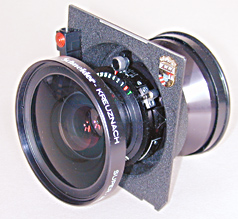
The Shneider Super Angulon.
Wideformat enlargements look so much better if a professional lens was used for the original photo. The quality of the seamless panorama photographs result from using a Schneider-Kreuznach lens on a 4x5 inch format camera.
 |
When you enlarge your photographs to the sizes possible with the new Wideformat printers, it helps to start out with a good lens.
Photos taken with a Tamron, Sigma, or Vivitar lens are okay for family snapshots and family vacation albums, but are inadequate for enlargement. I have seen photos from these cheap lenses that could not even survive enlargement to 8x10 without fuzing out.
To get the best Wideformat photo, a Schneider or Rodenstock lens is essential. It also helps to use large format, at least 4x5.
A scan of an 8x10 chrome, however, really produces an impressive Wideformat photo.
Schneider lenses are available for 4x5, 5x7, and 8x10 formats. Schneider lenses are also now available for medium format (6x6 cm) for Rollei cameras.
All the wide format photos pictured on FLAAR web sites were taken with a Leitz or Nikon lens (if 35mm), with a Zeiss lens (if medium format; no Schneider lenses were available for the Hasselblad years ago), and with Schneider or Rodenstock lens if large format.
We use 35mm only because most lecture venues have projectors only for 35mm slides. Otherwise medium format is our minimum size. When we moved up to digital photography, we selected a Better Light special adaptation of a Dicomed Field Pro, to keep with large format. It is recommended to use the new digital lenses. Both Schneider and Rodenstock make special lenses for use with large format digital scanning backs.
Most recently updated August 02, 2001.