Yuhan-Kimberly UJET MC2-P Digital Textile Printer.
In the years when Sensient ink company was owned by Yuhan-Kimberly was the first time I heard about the textile program of Yuhan-Kimberly. But I did not see any of their actual printers until years later, at SGIA 2007.

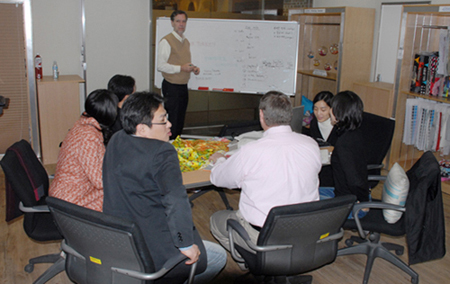
When at SGIA 2007 I mentioned that I would be in Korea to visit Dilli, the manager, Tim McCraw, invited me to visit their facility. Since I was arriving in Korea on a weekend (after spending a week in Taiwan to inspect GCC StellarJet 250UV printer), the only day I had available in Korea was a Saturday. Thus I appreciate the fact that the design team as well as all the managers came for a five-hour familiarization and print testing session, plus a several hour business dinner after that.
Since two FLAAR Reports resulted from this visit to Yuhan-Kimberly, it is easiest to present the material in these two PDFs rather than on this single page on the Internet. Most FLAAR Reports on textiles can be accessed at no cost.
|
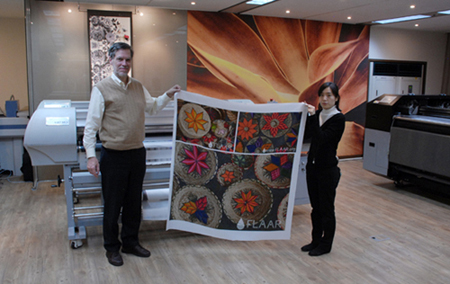
Nicholas Hellmuth in the Yuhan-Kimberly headquarters and textile printer demo room in front of the UJET MC2-P Digital Textile Printer. |

|
In 2009, the UJET MC2 has been replaced by the MC3.
UJET MC3-Express and UJET MC3-Premium are the newer textile printers from Yuhan-Kimberly. Each of these printers is now covered in a new FLAAR Report.
At ISA 2009, these two textile printers were rebranded as the Converd Green Machine P3 and the Converd Green Machine X3.
For textile materials (to use in any brand of textile printer), you should consider 3P Inkjet Textiles.
 |
Yuhan Kimberly P3 textile printer, at Converd booth, ISA 2009. |
|
|
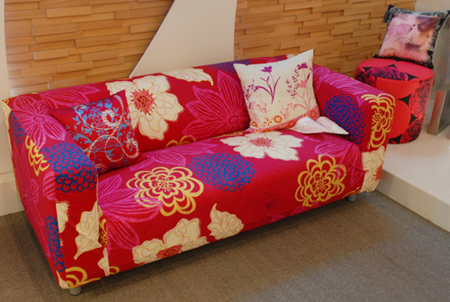
Samples made in Yuhan-Kimberly UJET MC2-P Digital Textile Printer. |
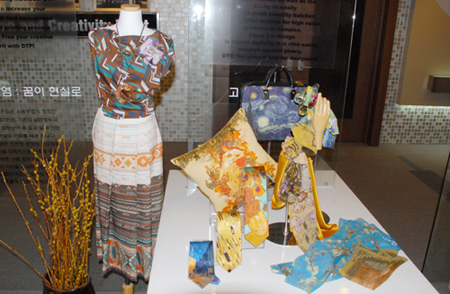
These printers are adapted significantly by Yuhan-Kimberly from the original Mutoh. The inks are from Yuhan-Kimberly which has experience with textile inks from the days of Encad and ColorSpan. So these are mature inks by a serious company.
Presently the market for textile printers is rising. But most companies are jumping into the easy disperse dye (direct to fabric with the sublimation unit attached to the printer) and dye sublimation (printing on transfer paper and then sublimating on a separate calendering heat press). So it is nice to see alternatives such as the Yuhan-Kimberly system that is for cotton and materials other than merely polyester.
During the month of February there will be new announcements as to the direction to be taken with these products as we enter a new era in textile printers. During this year the FLAAR Reports will be updating the PDF version of our reports (later in February) and adding comments on additional textile printers.
All pages on the Yuhan-Kimberly printers are in the process of being updated during February 2010.
Previously updated Jan. 2, 2008 and March 30, 2009.
|