Agfa's wide format inkjet printers (Sherpa and Grand Sherpa).
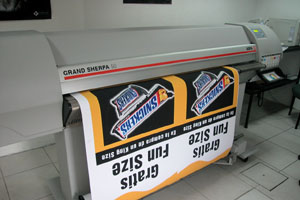 |
| The Grand Agfa Sherpa at testing. |
Agfa's older wide format printers are the 720 dpi version of the Mutoh Falcon. Agfa's former larger wide format printer is their OEM version of a ColorSpan with an Agfa-tuned Onyx PosterShop. Ilford provides a comparable package, an OEM ColorSpan with RIPStar, Ilford's version of Onyx's PosterShop. Today Agfa no longer offers the ColorSpan and has added their version of the Mutoh Falcon II, rebranded as the Grand Sherpa.
Whereas the original Mutoh is capable of 1440 dpi that is only in one direction and mainly multiples the time it takes to do a print, as in about two hours to do a banner. Perhaps Agfa opted for 720 dpi in order to make their printers a tad faster. Agfa is thus one of the few honest spec writers since they (originally) accepted only the 720 dpi. 1440 is primarily software enabled (Epson printers do not do true 1440, actually the Epson printheads used in all Agfa, Mutoh and other piezo printers of 2000-2001 are probably true 180 dpi). It's multiple passes which raises the dpi count to produce the fine quality which piezo is known for (and slows down the printer which piezo is also known for).
The
FLAAR network of hardware and software reviews does not
picture or discuss much Agfa equipment simply because due
to the huge size and international nature of such a large
company it is a challenge to find the right person who is
in charge of supplying equipment for testing. The other
reason is that Encad simply sent a NovaJetPro outright, then Hewlett-Packard
sent several large format printers as well. Next ColorSpan
sent a DisplayMaker
XII and last week a 72" Mach 12. Epson sent several
printers following that. This way we get to know the printers
quite well. When a company sends a demo unit only for 30
days we hardly have time to find out all the good things
the printer can do before the company asks for its printer
back. In such a case we have no way to use our drum-scanned
images to reveal the full quality that the printer is capable
of.
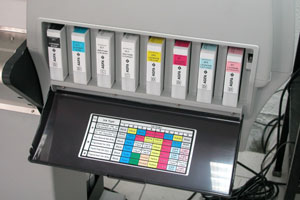 |
| Ink system of the Grand Sherpa. |
Until it is possible to have a GrandSherpa or Falcon II in our own facility to work with we show this snapshot of an Agfa Sherpa at DRUPA. We have also checked out the IT version of the Mutoh, the I-Jet; the Kodak versions of the Mutoh, their Kodak 4742 and Kodak 4760 and are looking at other Mutoh printers as well.
Don't judge the potential of this Agfa printer by this awful
snapshot. If you saw a photo from the FLAAR Photo Archive
on this same printer you would probably recognize the quality
and want to buy the improved version of a Mutoh. If you
would like more information on Mutoh printers, and how they
compare with their piezoelectric printhead brethren the
Epson, Mimaki,
and Roland,
then ask the review editor.
Now Agfa has the Falcon II OEMed as the Agfa GrandSherpa. We saw a prototype at Print '01. Downside of showing an unfinished printer is the unsightly banding. Usually it takes six months to get the printers improved to the point the banding can be avoided. Minor downside of the Mutoh Falcon II is that it reportedly uses the older Epson printheads (probably the ones used by Roland). Only printer to utilize the newest faster Epson printheads (of the Epson 10000) is the Mimaki JV-4.
As soon as the Agfa GrandSherpa is improved and has gotten rid of the banding we will report back.
If you really want technical details on inkjet media, inks, and/or inkjet printhead technology, and especially if you wish to meet the movers and shakers in this industry, be sure to sign up for the next conference organized by IMI. Their contact is [email protected]. These seminars are outstanding; the senior review editor of FLAAR usually attends because he can get so much fresh information for the readers of the FLAAR Reports in PDF format and the FLAAR Information Network of web sites.
Most recently updated June 24, 2002.
Previous updates:May 13, 2002, Feb 2002, July 06, 2001.