Drum scanner reviews and product comparisons between ICG, Howtek, Fuji, and Heidelberg.
The serious prepress drum scanners are ICG, Fuji, and Heidelberg. Entry level drum scanner is Howtek and Aztek.
The demand for drum scanners is rising despite the improvement in quality in flatbed scanners. At DRUPA trade show I asked several manufacturers of drum scanners why they were offering new models and the unanimous reply was that the worldwide demand for drum scanners was booming.
Nonetheless, several drum scanner companies fell by the wayside. Juno finally called it quits and Optronics drum scanners seem to have disappeared for the time being. Too bad, as we wanted to test an Optronics after we got a report from someone who owned one. He said the Optronics he had was inadequate and when it refused to function properly he used a Umax flatbed scanner. After contacting FLAAR he upgraded to a Scitex EverSmart Pro II.
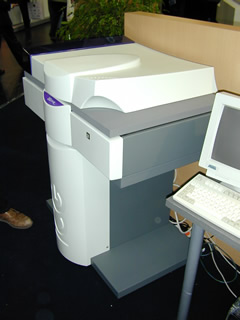
This was before we got a demo on an ICG drum scanner. This demo (at DRUPA, by Ian Smith) demolished our preconceived notions.
1st traditional myth, that you have to be a trained prepress professional to run a drum scanner. The new hardware and software of the ICG drum scanner can be operated by an person of reasonable intelligence. There are other drum scanners from other companies, or older models, that require experience and training. But the new ICG drum scanner can be operated by the same people that already work in your company.
 2nd
myth, that oiling the transparencies is a pain. Actually it
takes less time to oil the transparencies than it does to clean
off dust and scratches if you do the same transparency on a
flatbed scanner. When you oil the transparency that gets rid
of the majority of the dust and scratches so the resulting scan
is clean straight from the scanner.
2nd
myth, that oiling the transparencies is a pain. Actually it
takes less time to oil the transparencies than it does to clean
off dust and scratches if you do the same transparency on a
flatbed scanner. When you oil the transparency that gets rid
of the majority of the dust and scratches so the resulting scan
is clean straight from the scanner.
3rd myth, that a drum scanner of prepress quality costs between $80,000 and $140,000. Yes, several of the drum scanners are still in that price range. But ICG's new line of drum scanners are comparable in price to the best flatbed scanners.
Eventually we will get our hands on a Heidelberg and Fuji drum scanner. The tests of Aztek and Howtek resulted in unusable color balance. Since these respective companies did the tests themselves, we have absolutely no way to know whether the fault was in the original transparencies or the software or what. As a result, we feel that a proper evaluation is best done in our own facility.
Cruse sent a $97,000 reprographic stand scanner to our testing facilities, so we really know the pros and cons of this Rolls Royce of digital camera-copy stand scanner systems. Sure can handle all kinds of sizes and shapes of objects, up to several inches thick.
Here is the resultant drum scan. Sure stopped traffic at DRUPA trade show. This image printed via ColorGate software RIP on an Hewlett-Packard DesignJet 3000 CP.. I believe that's Dwight Davis of ColorGate in the picture. If you wish information on ColorGate software PostScript RIP, ask for the FLAAR Report on "RIPs + Help".
Most recently updated Aug.
1, 2002.
Previous updates: May 13, 2002, July 10, 2001.