Mimaki JV-4 and new flatbed printers from Mimaki offer viable options in wide format inkjet printing.
 |
The
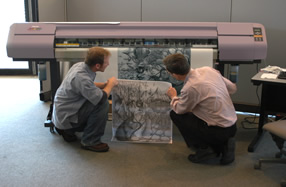
Mimaki JV-4 being test at BGSU facilities |
Mimaki and Mutoh both make acceptable printers but they simply are not as massively advertised as Epson or Roland. Since all these use Epson piezo printheads their performance has been too slow for sign shops or anywhere that fast production is necessary. ColorSpan, HP 5000, and some Encad printers have been the choice when a sign shop needed speed combined simultaneously with quality. But now Mimaki has a dual six-ink printer that is faster than any Epson, faster than a comparable Roland and simultaneously higher quality.
The better quality is because the Mimaki JV-4 uses the same heads as the Epson 10000 (not available in any Roland). But the Mimaki JV-4 uses dual sets, so is faster than Epson.
Past Mimaki models included Mimaki JV1300 evidently 360 dpi only, pigmented inks, piezo heads. The print heads can be raised to 1 mm up to accept thicker material. One millimeter is better than nothing.
Mimaki PV 90, was their six color system in recent past years.
Mimaki JV2 130, is an innovative seven color system (rather unusual) 6+1 pigmented ink. Evidently one use of the extra ink tank was for the special black inks for making masters for screen printing.
Raster Graphics is another printer that apparently OEMs from Mimaki. The new Kodak 5260 printer is, or was, manufactured by Mimaki. I say "was" because due to problems with the printheads (from Brother not from Mimaki) the printer has been delayed now over nine months). The delay is not the fault of Mimaki since they simply manufacture what Kodak sends them.
As with the Mutoh wide format printers, I see them and Mimaki printers occasionally at trade shows. It is rare that either Mutoh Inc or Mimaki Inc exhibit on their own. The combined result of lack of presence, lack of PR, and lack of advertising is that only about 1% of the people who send e-mails to FLAAR consulting service about what printer(s) they are considering buying ask about Mutoh or Mimaki. Most prefer the Encad, Epson or Hewlett-Packard. Others are thinking in terms of a Roland or ColorSpan. As a result of massive advertising Roland tended to be the choice at the high end (until people learned about the propensity of some Epson piezo printheads to produce horizontal banding defects). Encad and Hewlett-Packard are favorite choices for everything from entry-level first time users to experienced repro shops/copy shops, sign shops which want production workhorses.
Two years ago Encad itself announced it is abandoning the graphics art market this field is left wide open to Hewlett-Packard and Epson. Encad subsequently reentered the graphics arts market and is even interested in the fine art market, but its Lexmark printheads are a detriment in the rarefied atmosphere of fine art giclee printing.
 |
The
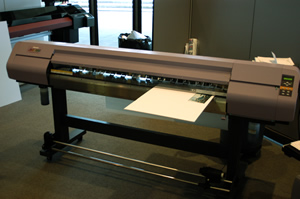
Mimaki JV-4 can print in thick materials. |
DicoJet inks for Mimaki printers.
Dicojet's special inks work on various of Mimaki's models. The main feature of Dicojet ink is their 7-color system, which naturally works best on a Mimaki JV2 130 printer. The problem is that Mimaki has no interest in helping sell DicoJet inks. Mimaki understandably wants to profit by selling its Mimaki inks (which it unlikely makes itself; most Japanese printer companies buy their inks from Toyo; HP inks come from Dupont or other companies and resell them under their own name). DicoJet, however, is its own ink company with plenty of experience in making its own inks.
We are definitely curious about the Dicojet 6+1 (7-color) system. We have heard mixed reactions to this product so will need to test it ourselves to find out whether the archival colors are bright enough to attract graphics artists.
New Mimaki JV-4 ushers in a new era for Mimaki.
It turns out that the most popular use for the new dual six-color Mimaki JV-4 is dye sublimation heat transfer, namely printing onto transfer paper for subsequent heat transfer onto textiles.
The Mimaki JV-4 is also capable of producing fine art giclee prints. In theory a Mimaki JV-4 should be considerably faster than any Roland. Interesting question is on output quality: eight color Roland Vs six color Mimaki. However Roland's own brochures indicate it can take up to two hours to do just one single large print in 32-pass mode on the Roland eight color machine. Yes, of course you can select faster modes, but the faster you print the less quality you get. This law of physics is true for every inkjet printer out there. Kodak is the first company which attempted to build a printer which could produce acceptable out put at fast speeds. Their first attempt failed; that's why the Kodak 5260 never appeared on the market. It turned out the printer could not achieve acceptable prints at the fastest speed (why and what's going on are all described in the FLAAR Reports on the Kodak 5260).
Difference between 12 in a Mimaki and 12 in a ColorSpan iis that ColorSpan offers 8 or 12 different colors of inks in addition to dual six colors. Mimaki is only dual six (or three times CMYK). You can't use 8 different colors; only six. In this respect the ColorSpan Esprit (eight colors) or ColorSpan DisplayMaker XII (six, eight or full 12 individual colors) are more flexible. FLAAR has a ColorSpan with dual sets of six dye inks; very fast, outstanding color depth.
The Mimaki can reportedly be tweaked and fine tuned to eliminate banding. Banding is an inherent problem with all inkjet printheads, including those of HP and ColorSpan, but of all the fine art printers, banding tends to be most noticeable on Roland. We are keeping an eye out on the Mimaki, but early reports indicate that it has mechanical means of registration to eliminate banding.
Mimaki already has two flatbed printers on the market. Now that Encad has demonstrated that the flatbed market is a growing one, it will be interesting to see new and different Mimaki flatbeds. FLAAR editors will be at the upcoming tradeshows checking out what is available.
 |
Installing
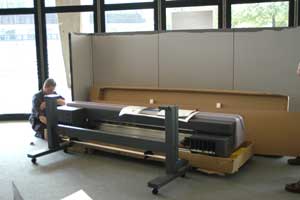
the JV-4 at our facilities in BGSU |
For additional information and for help making your decision, ask for the "FLAAR report on signs, posters, banners" (specify whether for indoor signs or outdoor signs in the rain and sun) or for the FLAAR report on "Piezo Vs Thermal printheads, fact Vs fiction, pros and cons of each kind of inkjet printhead." You can also ask for the report on "Media and Inks for Photo-Realistic and Fine Art Giclee," or "Media and Inks for Sign Printing with Large Format Inkjet."
If this will be your first printer, then we have a special report that holds your hand and leads you through all the basic questions that will assist a first-time buyer of a large format printer. Purchase the FLAAR report on "RIP + Help." This explains what RIP software is, why this is useful, and includes tips, warnings, information, and help for a wide range of matters for a newbie. Here you will really appreciate that FLAAR is based at a university; Professor Hellmuth has plenty of experience writing in a manner that explains what you need, and why.
Based on our surveys of piezo printers, at present the Mimaki JV-4 appears to be the best on the market. Has all the advantages of the Epson 10000 (high quality) but none of the downsides of the Epson 10000 (you are stuck with just one ink kind). With Mimaki you can use any kind of ink you wish. Mimaki is the most ink-friendly printer available anywhere.
If you really want technical details on inkjet media, inks, and/or inkjet printhead technology, and especially if you wish to meet the movers and shakers in this industry, be sure to sign up for the next conference organized by IMI. Their contact is [email protected]. These seminars are outstanding; the senior review editor of FLAAR usually attends because he can get so much fresh information for the readers of the FLAAR Reports in PDF format and the FLAAR Information Network of web sites.
Most recently updated Feb 20, 2002